
Tadasana (Mountain Pose) is the foundation of all yoga — a practice of standing fully alive and aligned, activating the Root Chakra and the art of complete presence.
Tadasana: The Foundation of All Standing Poses
The name tadasana comes from the Sanskrit tada, meaning mountain, and asana, meaning posture. It is commonly called Mountain Pose and, on the surface, it looks like simply standing. This appearance is deceptive. Done well, tadasana is one of the most demanding postures in a yoga practice, not because it strains the body but because it requires a quality of full, conscious attention that is genuinely difficult to sustain. Every part of the body is involved. Every part must be awake.
In Iyengar yoga, tadasana is the mother of all standing poses. The alignment principles established here carry into every other standing asana in the sequence. A practitioner who has not learned to stand correctly will repeat their postural compensations in every subsequent pose. Conversely, a practitioner who understands tadasana has a stable foundation from which all other standing positions can be understood and refined.
What Standing Correctly Actually Means
Most people believe they know how to stand. They are usually mistaken. The habitual standing posture of most adults involves a combination of collapsed arches, locked knees, tucked or anteriorly tilted pelvis, rounded shoulders and a forward-jutting head. None of these are neutral. They are adaptations to footwear, furniture, stress and habit. Tadasana asks the practitioner to investigate their actual relationship with verticality.
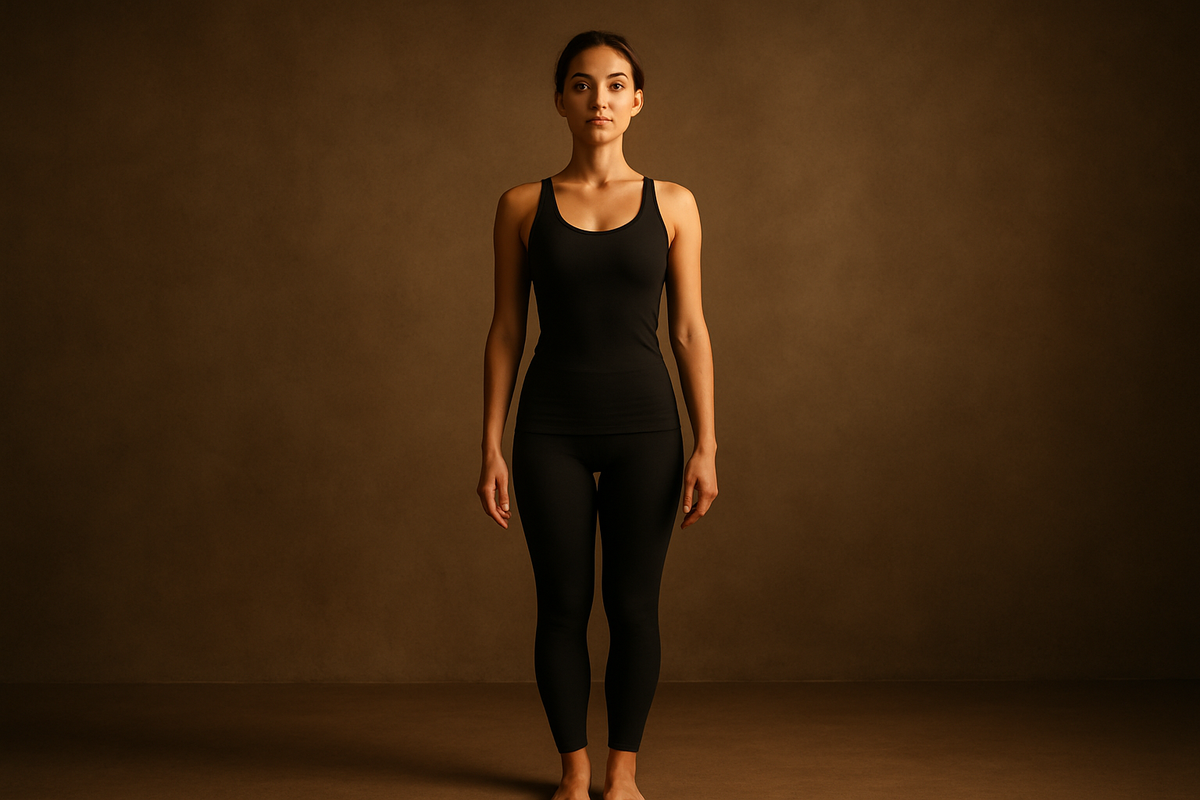
Standing correctly in tadasana does not mean rigidly braced. It means organised. The weight of the body distributes evenly across all four corners of each foot: the base of the big toe, the base of the little toe, and the two points of the heel. The arches of the feet are active, not collapsed. The ankles are directly above the outer edges of the feet rather than rolling inward. The knees are neither locked back nor excessively bent, but engaged and tracking over the second toe. The pelvis is neither tucked under nor tipped forward, but in a neutral position where the front hip points and the pubic bone are in the same vertical plane.
Alignment Cues from Feet to Crown
Feet and Legs: The Ground of the Pose
Begin by standing with the feet together or hip-width apart. Press all four corners of both feet into the floor simultaneously. Notice that activating the arches slightly lifts the inner ankles and engages the inner thighs. Draw the kneecaps upward by gently contracting the quadriceps, but do not hyperextend the knees. The femur bones rotate very slightly outward as the inner thighs draw back and apart.
Pelvis and Core: The Centre
Find the neutral pelvis by placing your hands on your hip bones. Tilt the pelvis forward and back a few times to feel the range, then settle at the midpoint where neither the lower back is exaggerated nor flattened. Draw the low belly gently inward and upward, not forcefully, but as a light, background tone of engagement. This protects the lumbar spine and creates a stable base for the torso above.
Chest, Shoulders and Head: The Crown
Lift the sternum away from the navel. Spread the collarbones wide. Draw the shoulder blades toward each other and then allow them to release slightly down the back. The arms hang freely, palms facing the thighs, with the fingers long and soft. The chin is parallel to the floor, neither jutting forward nor tucked back. The crown of the head rises toward the ceiling as if a thread draws it gently upward. The face is relaxed.
Body Awareness, Proprioception and the Earth Element
Proprioception is the body's capacity to sense its own position in space. It depends on receptors in the muscles, tendons and joints sending continuous feedback to the brain about where each part of the body is. In tadasana, holding still while actively maintaining alignment trains proprioception in a way that few exercises do. The practitioner must notice subtle shifts of weight, micro-adjustments in the ankles and hips, and the constant small corrections the body makes to maintain balance.
In the system of the five elements used in Ayurveda and classical yoga, the earth element is associated with stability, groundedness and physical presence. Muladhara, the root chakra at the base of the spine, governs this quality. Tadasana, as a pose that connects the body to the floor through the feet and cultivates a felt sense of weight and stability, is directly associated with the earth element and the activation of muladhara. Standing in tadasana with full attention is a brief but real grounding practice.
How Poor Tadasana Affects Every Other Pose
The Cascade of Misalignment
When the feet pronate and the arches collapse in tadasana, the inner knees track inward, the pelvis rotates, and the lower back compensates. This cascade does not stop when the practitioner moves into a warrior or a triangle pose. It travels upward through every standing posture. A warrior II with collapsing arches places uneven load on the hip joint. A trikonasana with a tilted pelvis strains the lumbar spine rather than stretching the side body. The errors compound.
The Practice of Returning
One of the deepest lessons of tadasana is that alignment is not a destination arrived at once and maintained forever. It is something the practitioner returns to, again and again, as attention wanders and the body drifts. This is not failure. It is the nature of practice. Tadasana teaches the practitioner to notice drift and return without judgment, a skill that extends directly into meditation, into mindfulness, and into daily life.
Featured Programme
The I AM Programme
A complete course in nondual mindfulness, yoga and self-inquiry for adults seeking clarity and grounded presence.
Explore the ProgrammeWritten by
Editorial Team

