
Step into the strength and courage of Virabhadrasana I — Warrior I. Build powerful legs, open hips and chest, and embody the fierce grace of the mythical warrior.
Among the standing poses of yoga, the Virabhadrasana family (Warrior I, II and III) holds a unique place. They are simultaneously among the most physically demanding and the most psychologically rich postures in the canon. They build strength, balance and stamina in the body. And if practised with awareness, they cultivate something more intangible: the capacity to remain grounded, focused and open-hearted in the face of challenge.
Understanding where these poses come from and why they are named for a warrior reveals their deeper purpose.
The Mythology of Virabhadra
The Warrior poses are named for Virabhadra, a figure from Hindu mythology described in the Shiva Purana. The story begins with Sati, the beloved consort of Shiva, who attends a great sacrificial ceremony hosted by her father Daksha. Daksha publicly humiliates Shiva and refuses to acknowledge his greatness. Unable to bear this dishonour to her husband, Sati throws herself into the ceremonial fire and dies.
Shiva, consumed by grief and rage, tears a lock of his hair and drives it into the earth. From this act of grief transformed into force, Virabhadra arises: a great warrior with a thousand arms, carrying weapons, wearing a garland of skulls. He appears as Warrior I (arriving from the sky), Warrior II (surveying the battlefield), and Warrior III (delivering the decisive blow). His purpose is not aggression for its own sake. It is the fierce compassion of a being who acts decisively in service of truth and love.
This story transforms the poses. To practise the Warriors is not merely to build strong legs. It is to embody the quality of consciousness that acts with clarity, courage and an open heart. The inner warrior is not the one who conquers others, but the one who overcomes fear, distraction and the habit of contraction.
Warrior I (Virabhadrasana I): The Arrival
Warrior I at a Glance
Primary Stretch
Hip flexors of the back leg; chest; anterior shoulders
Primary Strength
Quadriceps; glutes; spinal extensors; shoulder girdle
Key Challenge
Squaring the hips toward the front while keeping the back heel grounded
Hold Duration
5–10 breaths each side; longer holds build more hip flexor release
Warrior I is a powerful lunge with the arms raised overhead and the torso facing the front of the mat. From Mountain Pose, step the right foot forward 3–4 feet, bending the front knee to 90 degrees. The back foot turns in approximately 45–60 degrees, which is more than in Warrior II, and the hips rotate to face forward. The arms rise overhead, palms facing or touching, with the shoulder blades drawing down away from the ears.
The hip flexors of the back leg receive a deep stretch as the pelvis tilts slightly anteriorly and the front knee bends deeply. This is the primary therapeutic gift of Warrior I for desk workers: it reverses the hip flexor shortening created by hours of sitting. Simultaneously, the raised arms and open chest counteract the thoracic rounding of forward head posture. The pose is both a physical correction and, in the mythological sense, an arrival and claiming of presence.
The most common alignment problem is the back heel lifting, which usually indicates too long a stance or too-tight hip flexors. Reduce the stance length and turn the back foot in less. Never collapse the front knee inward; it must track over the second toe throughout.
Warrior II (Virabhadrasana II): The Survey
Alignment and Setup
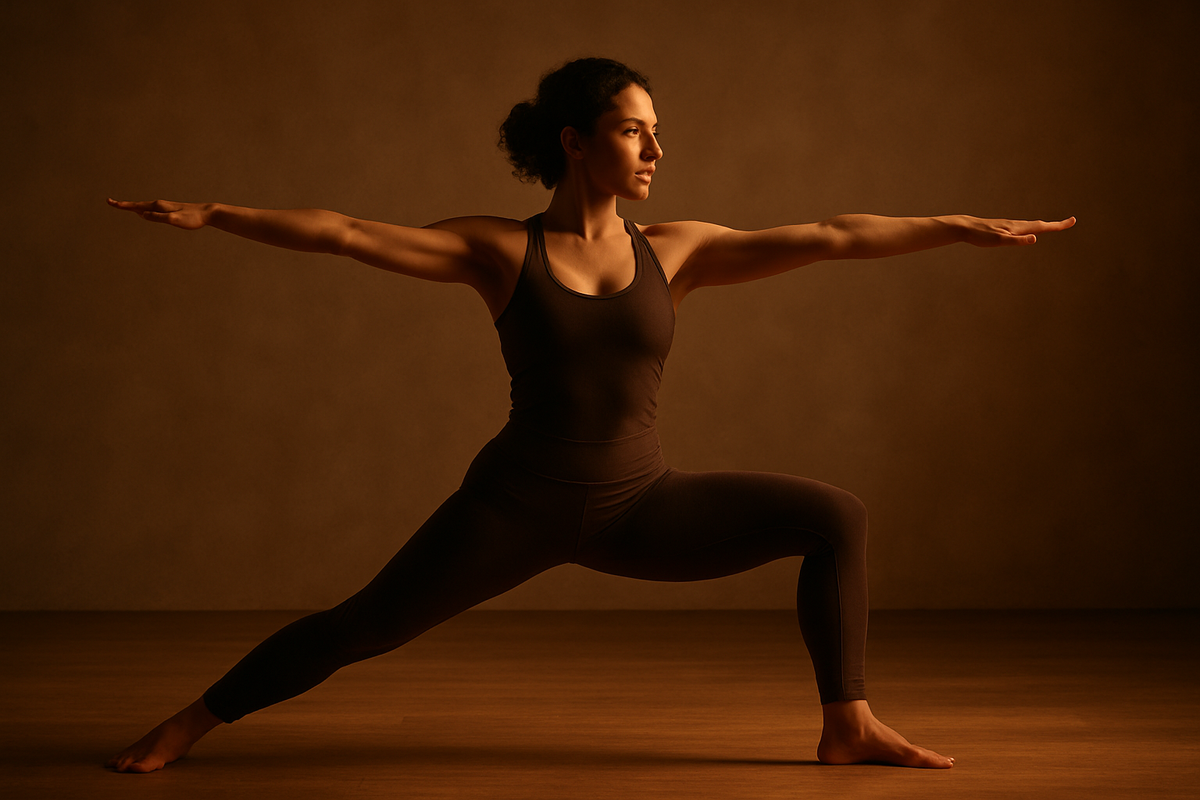
Warrior II opens the body to the side rather than the front. Stand with feet 4–5 feet apart. Turn the right foot out 90 degrees and the left foot in 15 degrees. Bend the right knee to 90 degrees, the thigh aiming parallel to the floor and the knee directly above the ankle. Extend both arms out to the sides at shoulder height, palms facing down. The gaze (drishti) goes over the right middle finger. The torso remains upright; do not lean forward or back.
The Unique Benefits of Warrior II
Warrior II develops hip strength and endurance in a way no other standing pose matches. The bent front leg must sustain significant load while the hip abductors of the back leg work hard to keep the pelvis stable. Research on hip abductor strength shows it is a critical factor in knee health, lower back stability and athletic performance, making Warrior II one of the most therapeutically valuable poses in the entire asana repertoire.
The extended arms at shoulder height build shoulder girdle endurance, while the open-hipped stance stretches the inner groins and hip external rotators. The gaze over the front hand, steady, clear and unflinching, embodies the warrior's quality of focused presence. In the mythological frame, this is the moment of survey: the warrior sees the situation clearly before acting.
Common Mistakes in Warrior II
The front knee collapsing inward, known as valgus collapse, is the most dangerous error: it places shear stress on the medial knee structures. Actively press the front knee toward the little-toe edge of the front foot to maintain alignment. The second most common error is the front thigh not reaching horizontal, due to insufficient flexibility, strength or stance width. Widen the stance and work with time. Avoid overarching the lower back; keep the tailbone slightly tucked.
Warrior III (Virabhadrasana III): The Integration
Alignment and Entry
Warrior III is yoga's quintessential balance pose: a single-leg standing posture with the body in a horizontal T-shape. From Warrior I on the right side, begin to shift weight into the right foot. As you straighten the right leg, the left leg lifts behind you, the torso comes forward, and the arms extend overhead. The body creates a single plane from the fingertips to the left heel, horizontal and parallel to the floor. The standing leg is straight but not locked, the hip of the lifted leg is square to the floor (not externally rotated), and the gaze is steady on a fixed point.
The Unique Benefits of Warrior III
Warrior III is a full-body integration pose that simultaneously challenges balance, proprioception, core stability, hip extension strength and focus. EMG research shows that single-leg balance poses like Warrior III activate the gluteus medius, the deep hip stabiliser and one of the most commonly weak muscles in sedentary populations, at very high levels. This makes it not just a balance challenge but a genuinely rehabilitative exercise for hip and knee stability.
The sustained concentration required to remain in Warrior III without wobbling trains the attentional capacity of the prefrontal cortex, quite literally the neurological substrate of focused awareness. Every breath in Warrior III is a small act of choosing to be present rather than allowing the mind (and body) to scatter.
Building to Warrior III
For those new to the pose, working at a wall is invaluable: stand facing the wall at arm's length, place both hands on the wall, and practise lifting one leg behind you while the hands provide support. A block beneath the hands (instead of the floor) is also useful for those who cannot reach horizontal with a straight back. Gradually reduce the support as strength and balance develop.
Featured Programme
The I AM Programme
A programme that builds the inner warrior through yoga philosophy, mindfulness and nondual inquiry for lasting transformation.
Explore the ProgrammeThe Inner Warrior: What the Poses Really Teach
B.K.S. Iyengar described the Warriors as ferocious poses, not because of their mythology, but because they demand something real of the practitioner. To hold Warrior II for 10 breaths when the thighs are burning and the mind is insisting that you stop is a training in something more fundamental than flexibility or strength. It is a training in presence: the capacity to be fully here with what is difficult, without collapsing or reacting.
This is the bridge between yoga as physical practice and yoga as a path of self-understanding. The inner warrior is not the ego that forces and pushes. It is the awareness that remains stable, open and clear even in the midst of difficulty. It is the quality of consciousness that says: I can stay here. I am not destroyed by this. I remain.
Frequently Asked Questions
Which Warrior pose should I learn first?
Most teachers introduce Warrior II first. It is more accessible than Warrior I for beginners because it does not require the challenging hip squaring of Warrior I, and it is more stable than Warrior III. Once Warrior II is established with solid alignment, Warrior I can be added. Warrior III is typically introduced last, after balance and single-leg strength have developed through simpler poses. That said, all three can be explored simultaneously at appropriate depths. There is no rigid requirement to complete one before attempting another.
How long should I hold the Warrior poses?
For physical and psychological benefit, longer holds are generally more valuable than brief ones, provided alignment is maintained. 5–10 breaths is the minimum useful duration for each side. Experienced practitioners often hold for 15–20 breaths, particularly when building toward the deeper experiences the poses offer. For therapeutic purposes (such as hip flexor release or gluteus medius strengthening), 30-second to 2-minute holds on each side, practised daily, produce the most consistent results.
Can Warrior poses be practised with knee problems?
With modifications, yes. The key principle is ensuring the front knee never collapses inward and never extends beyond the ankle. For anyone with patellofemoral pain (front-of-knee pain), reducing the depth of the front knee bend (rather than 90 degrees, perhaps 45–60 degrees) significantly reduces compressive load while maintaining the benefits of the pose. Chair-supported versions of all three Warriors allow people with significant knee concerns to access the core and upper body benefits. Always work within a pain-free range and seek individualised guidance for specific knee conditions.
Written by
Editorial Team

