
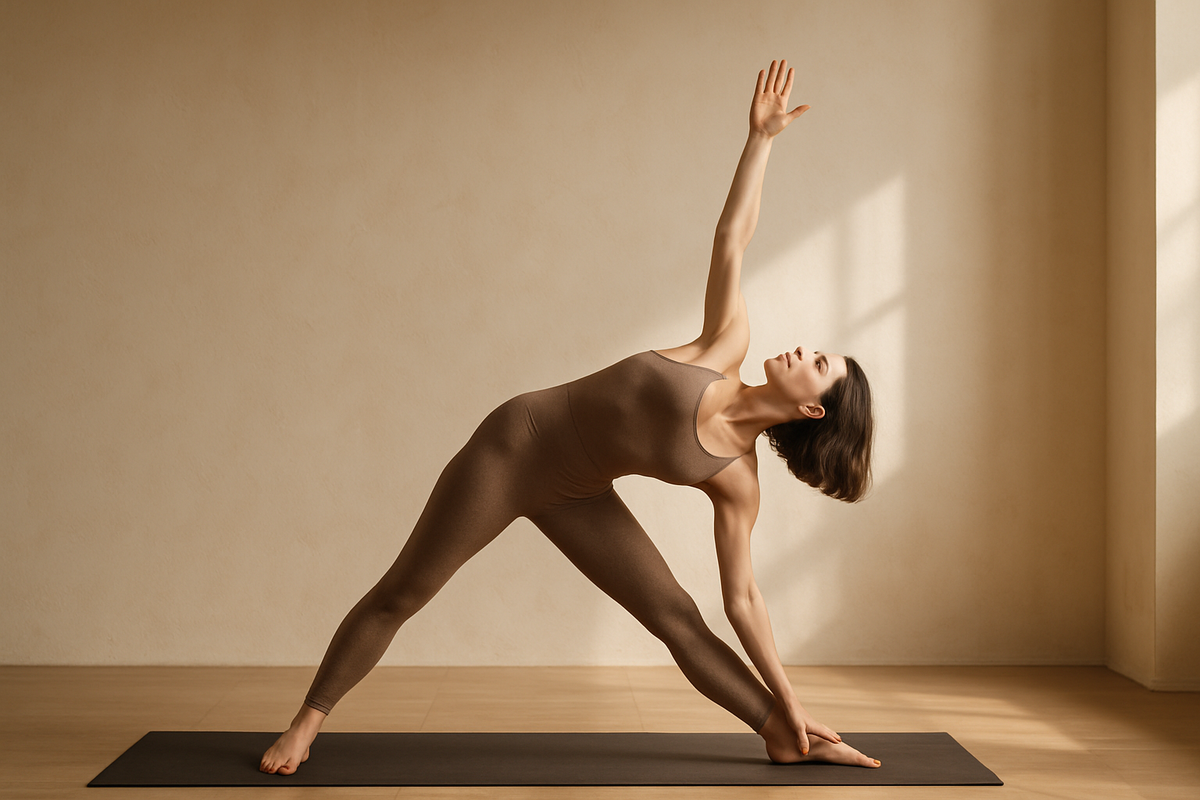
Trikonasana (Triangle Pose) is a cornerstone standing posture stretching the hamstrings, opening the chest, and activating the Sacral Chakra with geometric precision and expansive grace.
Trikonasana, or Triangle Pose, is one of yoga's most iconic standing postures. It appears in virtually every Hatha, Iyengar and Vinyasa tradition, and for good reason: when practised with precision and awareness, it offers a remarkable combination of lateral spinal lengthening, deep hip and hamstring opening, thoracic rotation and full-body balance challenge, all in a single, elegant shape.
The word comes from the Sanskrit "tri" (three) and "kona" (angle), describing the three angles formed by the body: the two legs and the torso. Understanding these angles and how to work with them intelligently is the key to unlocking the pose's full potential.
The Benefits of Trikonasana
Trikonasana: Key Benefits at a Glance
Lateral Spine
Lengthens the intercostal muscles and lateral chain; counteracts lateral compression from poor posture
Hamstrings
Provides a strong eccentric hamstring stretch with the leg in abduction — different from forward folds
Hip Abductors
Opens the inner groins and strengthens the outer hip of the standing leg
Thoracic Rotation
The gaze and upper arm rotation mobilise the thoracic spine — often stiff in desk workers
Balance
Challenges proprioception and single-leg stability in a wide-stance position
Digestion
The abdominal compression on one side and extension on the other stimulates digestive organs
Step-by-Step Alignment: Utthita Trikonasana (Extended Triangle)
1. Feet: The Foundation
Stand with feet approximately 3–4 feet apart. The exact distance depends on your proportions: your ankle should be roughly beneath your wrist when you extend both arms out to the side. Turn the right foot out 90 degrees so the toes point directly to the right. Turn the left foot in approximately 15–30 degrees. The right heel should be approximately in line with the left arch. Press firmly through all four corners of both feet.
2. Legs: Engaged and Active
Both legs should be straight, not locked or hyperextended, but actively engaged. Lift the kneecaps by contracting the quadriceps. The right kneecap should track over the second toe. The outer edge of the back foot presses firmly into the mat. Activate the inner thigh of the front leg to prevent the knee from collapsing inward.
3. The Lateral Reach
Extend the right arm out to the right as if reaching for something on a shelf, maintaining the full length of the right side of the torso. The tendency is to collapse into the side bend rather than lengthen through it. Think of creating space between the right hip and the right armpit before you begin to descend. Then allow the right hand to rest on the shin, ankle or a block, wherever it lands without the torso shortening.
4. The Upper Body
Rotate the left arm up toward the ceiling so both arms form a single vertical line. The gaze can be forward, or follow the upper hand toward the ceiling. Only lift the gaze if the neck is comfortable. The chest should face forward (or slightly toward the ceiling), not downward toward the floor. The left shoulder stacks above the right. If the upper shoulder is rolling forward, place the hand on the hip instead and focus on opening the chest.
5. The Spine
This is where most practitioners make their critical error: they allow the spine to curve laterally (collapsing toward the floor) rather than extending long. The entire spine should remain as straight and long as possible. The pose is a lateral extension, not a lateral collapse. Imagine the crown of the head reaching toward the right wall and the tailbone reaching toward the left wall, creating axial length throughout.
Parivrtta Trikonasana: The Revolved Variation
Parivrtta Trikonasana (Revolved Triangle Pose) is a more challenging variation that adds a significant spinal twist. Starting from the same wide stance, the front foot turns out 90 degrees. The opposite hand descends toward the front foot while the chest and gaze rotate upward. The back leg is straight and strongly engaged.
The revolved variation requires significantly more hamstring and thoracic flexibility, as well as strong core engagement to prevent the torso from collapsing. It is best approached after the standard Triangle is well established, and always with a block beneath the lower hand. The twist provides deep detoxifying compression of the abdominal organs and a powerful thoracic rotation that standard Triangle does not offer.
Common Mistakes and How to Correct Them
The most common error in Trikonasana is placing the hand too low, on the floor before the body is ready, causing the torso to shorten, the spine to round and the chest to close. Use a block set to the appropriate height so the hand has support without compromising length. The second most common error is the back hip hiking up toward the ear, reducing the lateral extension. Press through the outer back foot and draw the back hip slightly downward to square the pelvis. Finally, many practitioners collapse the ribcage toward the floor: keep the right ribs lifting rather than compressing toward the earth.
Featured Programme
The I AM Programme
A structured yoga and mindfulness programme that takes your practice beyond the physical into awareness and inquiry.
Explore the ProgrammeHow Trikonasana Fits in a Sequence
Trikonasana works well in the middle phase of a standing sequence, after the body is warmed up but before deeper hip openers or forward folds. A natural sequence: Mountain Pose → Warrior II → Extended Side Angle → Triangle → Revolved Triangle → Pyramid Pose → Wide-Legged Forward Fold. This progression builds progressively from strength-oriented poses toward lengthening, respecting the body's need for a warm-up before deep hamstring and hip work.
Contraindications and Modifications
Those with recent hamstring injuries should approach with extreme caution: use a higher block and prioritise spinal length over depth. Individuals with low back disc injuries should avoid deep lateral flexion until cleared by a physiotherapist. Neck injuries may require keeping the gaze forward or downward rather than up. Anyone with balance challenges or recent ankle injuries should practise near a wall for support.
Frequently Asked Questions
Should my hand touch the floor in Trikonasana?
Not necessarily. Forcing it to do so is one of the most common ways practitioners injure themselves in this pose. The hand touching the floor is only appropriate when the hamstrings and lateral body are flexible enough to allow it without shortening the spine, collapsing the chest or rounding the back. A block at its highest height is the ideal starting point for most practitioners. Over time, as flexibility increases, you can lower the block or bring the hand to the shin rather than a prop. The quality of the spine always takes priority over the height of the hand.
Why do I feel this pose more on one side?
Asymmetry in Triangle Pose is extremely common and usually reflects the asymmetries of daily life. We tend to carry bags on one side, sleep on one side, and habitually shift weight to one hip. The tighter side usually reflects the part of the body that is more overworked or chronically contracted. Practising the more challenging side first (before you are tired) and holding it slightly longer is a useful approach. Over months of consistent practice, meaningful symmetry improvements are typical.
Can Trikonasana help with sciatic pain?
Many yoga therapists use Trikonasana as part of sciatic pain protocols, as it gently stretches the piriformis and hamstrings, muscles that can compress the sciatic nerve when tight. However, approach with care. If the pose provokes radiating leg pain or tingling, stop immediately and consult a physiotherapist. Piriformis-related sciatica often responds well to Triangle Pose; disc-related sciatica may be aggravated by it. Individualised guidance is essential for sciatica.
Written by
Editorial Team

