
Setubandhasana (Bridge Pose) is a versatile supine backbend that strengthens the glutes, opens the heart, and activates the Anahata Heart Chakra with equal accessibility and depth.
Setubandhasana: Building the Bridge
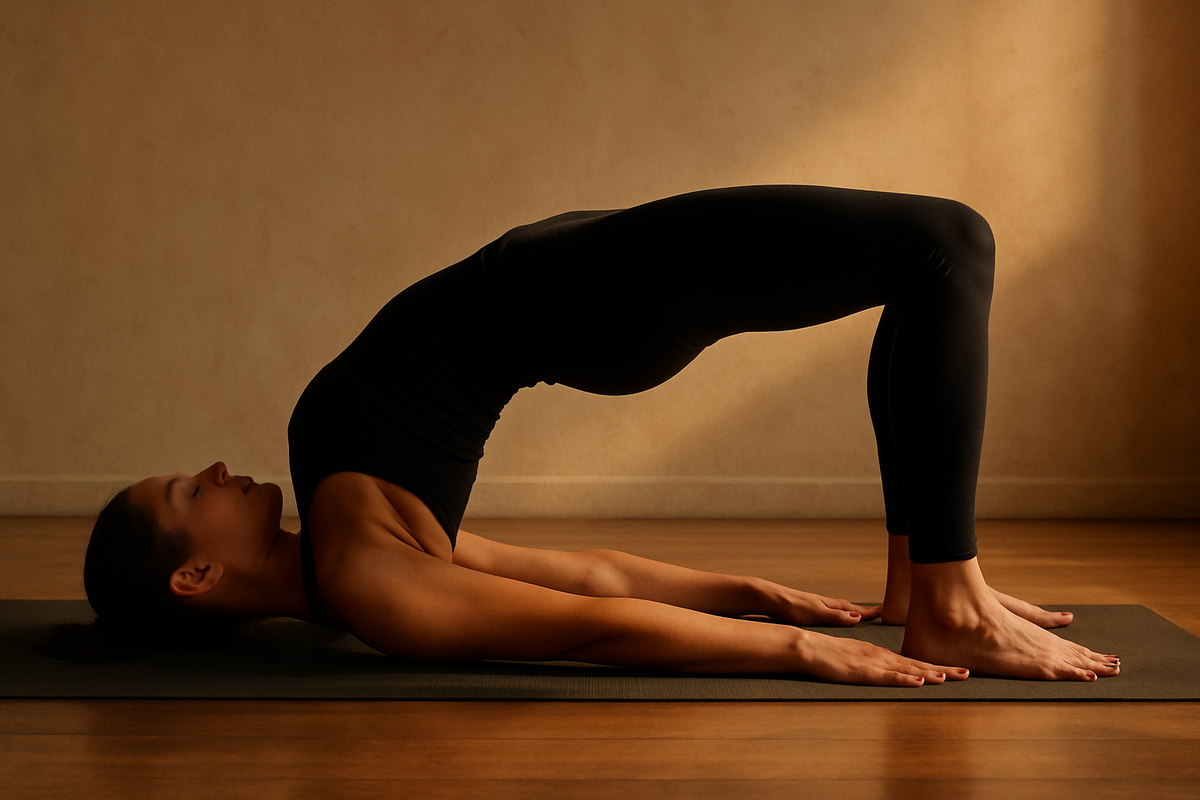
The name setubandhasana comes from the Sanskrit setu, meaning bridge or dam, bandha, meaning bond or lock, and asana, meaning posture. The full name is often rendered as setu bandha sarvangasana in Iyengar traditions, where it is understood as a preparation for shoulderstand. In most contemporary yoga classes it is simply called Bridge Pose. The shape is clear: the supine body arches upward from the floor, the chest lifting, the spine curving, the pelvis rising, and the whole structure held between the feet pressing down and the shoulders pressing back.
Bridge pose is versatile. It appears in restorative practice as a supported, passive backbend. It appears in vinyasa sequences as a dynamic, active lift. It serves as a preparation for deeper backbends such as urdhva dhanurasana, the full wheel, and it stands as a complete, satisfying practice in its own right. For practitioners with lower back pain or fatigue, the supported version in particular can be genuinely therapeutic.
Step-by-Step: How to Practise Bridge Pose
Setup: Preparing the Foundation
Lie on your back with your knees bent and your feet flat on the floor, hip-width apart and parallel. Your heels should be close enough to your sitting bones that you can just touch them with your fingertips when your arms are extended alongside your body. Place your arms along your sides, palms facing down. Press your feet evenly into the floor and take a breath to settle. The lower back may have a small natural curve lifting it slightly away from the mat. This is fine.
Entry: Lifting the Pelvis
On an exhale, press both feet firmly into the floor. On the inhale, lift the pelvis, then the lower back, then the mid back away from the mat. Roll up through the spine until the torso forms a diagonal line from knees to shoulders. The thighs should be parallel to the floor or angled slightly upward. Draw the inner thighs toward each other without letting the knees splay outward. Interlace the fingers beneath the pelvis and walk the shoulders toward each other, broadening the chest. Press the outer edges of the shoulders and the backs of the arms into the mat.
Hold: Sustaining and Breathing
Hold for five to ten breaths. With each inhale, lift the sternum toward the chin. With each exhale, press the feet down and feel the hamstrings and glutes working to maintain the height of the pelvis. To come down, release the hands if interlaced, and lower the spine slowly to the floor on an exhale, vertebra by vertebra, from the upper back down to the tailbone. Rest for a few breaths before repeating or moving on.
Physical Benefits: Glutes, Hamstrings, Spine and Shoulders
Bridge pose is one of the most effective exercises for the posterior chain. The gluteus maximus, the largest muscle in the body, works hard to maintain pelvic height. The hamstrings assist, contracting to keep the knees from straightening and the pelvis from dropping. Over time, this kind of sustained isometric work builds genuine strength in these muscles, which supports healthy gait, reduces the risk of hamstring injury and contributes to lower back stability.
The spinal extensors, running alongside the lumbar and thoracic vertebrae, also engage to maintain the arch of the back. The shoulder blades draw together and down, opening the front of the chest and stretching the pectoral muscles. This chest opening counteracts the rounding of the shoulders that develops from prolonged forward-facing activities such as driving, typing and using a phone. The throat and neck receive a gentle stretch as the chin lifts.
Hip flexors, which are often tight in people who sit for long periods, are stretched in bridge pose as the pelvis tilts and lifts. The rectus femoris, one of the quadriceps muscles that crosses the hip joint, is also lengthened. This combination of posterior chain strengthening and anterior chain stretching makes bridge pose particularly valuable for desk-based practitioners.
Heart Chakra Connection and Therapeutic Uses
Opening the Heart: Anahata Chakra
Any pose that lifts the sternum and expands the chest is associated in yogic anatomy with the Anahata chakra, the heart energy centre. Anahata governs the capacity for love, compassion, connection and the giving and receiving of care. When the chest is habitually closed, rounded or guarded, the energetic quality associated with Anahata tends to contract as well. Bridge pose, by physically opening the chest and creating a sense of expansion through the heart region, is considered a direct practice for this centre.
Therapeutic Applications: Back Pain and Fatigue
The supported version of bridge pose, in which a yoga block is placed beneath the sacrum and the body rests passively over it, is one of the most commonly prescribed restorative postures for lower back fatigue and mild disc discomfort. In this variation there is no muscular effort. The spine simply drapes over the block, creating a gentle, sustained extension through the lumbar region. This can relieve compression and shift the quality of pain or tightness in the area for many people. It is also deeply calming and is often used to transition into yoga nidra or savasana.
Modifications, Progressions and Cautions
Supported Bridge: The Block Variation
Place a yoga block (at its lowest, medium or highest setting depending on flexibility) beneath the sacrum, the flat triangular bone at the base of the spine. Allow the body to rest completely. The arms can lie alongside the body or extend overhead. This version can be held for two to five minutes with ease and produces a very different quality from the active pose: it is receptive rather than effortful.
Progression: Toward Wheel Pose
For practitioners interested in deeper backbends, bridge pose is an important preparation for urdhva dhanurasana, or wheel pose. The shoulder flexibility, spinal extension and hip flexor lengthening developed in bridge all contribute directly to the wheel. Spending several months building bridge pose before attempting wheel is a worthwhile investment in both safety and depth.
Cautions: When to Modify
Those with neck injury should avoid rolling the shoulders beneath the body in the active variation. Anyone with recent knee injury should ensure the feet are properly aligned and avoid any outward splaying of the knees. Pregnant practitioners can practise supported bridge up to the second trimester with care, but should consult a prenatal yoga teacher for specific guidance.
Featured Programme
The I AM Programme
A complete adult course in nondual mindfulness, yoga and self-inquiry. Open to what is already present.
Explore the ProgrammeWritten by
Editorial Team

